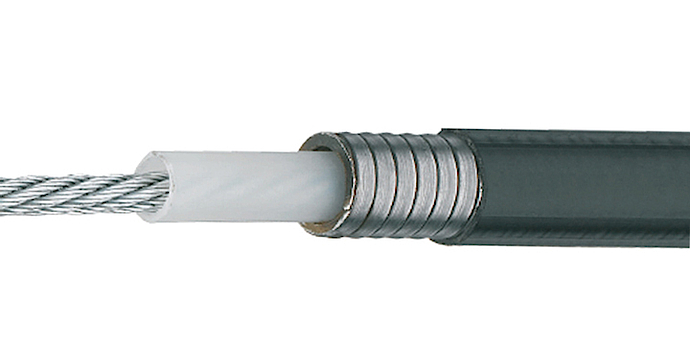
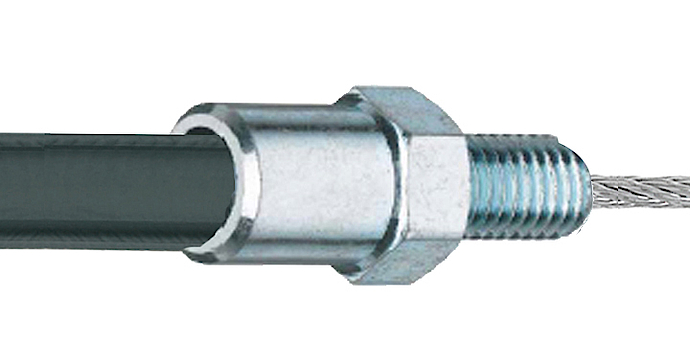
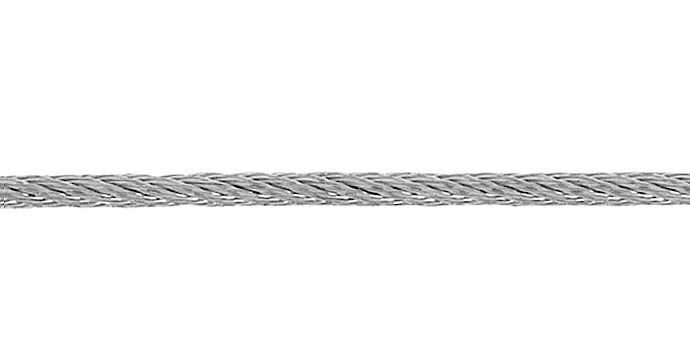
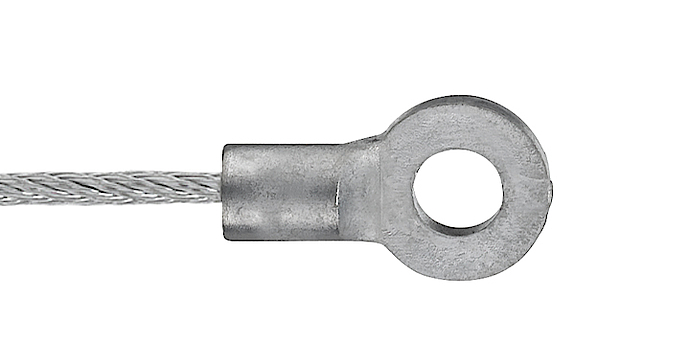
As an experienced manufacturer and supplier of custom bowden cables and push-pull control cables, we assemble your bowden cable to fit your application perfectly. Our bowden cables consist of pressure-resistant spiral sheaths combined with assembled steel wire ropes as the pulling element. In addition, a flexible POM lining tube can be inserted between the spiral sheath and the steel wire rope to increase efficiency.
We are a manufacturer of custom-made bowden cables. We can manufacture bowden cables or push, pull, and actuator cables exactly to your specifications. By selecting the right components, we can guarantee a wide range of possible functions. As a supplier of custom bowden cables for industry, our tailor-made bowden cables are used in a wide range of sectors. We develop tailor-made solutions for controlling mechanical functions in mechanical and plant engineering, precision engineering, conveyor technology, robotics, medical technology, and many other areas.
A bowden cable is made up of several parts. The bowden cable assembly starts with a sleeve and a bowden cable core. The core is made from high quality steel wire. The bowden control cables steel or stainless steel sleeves and other components can be assembled individually. The numerous standard components allow a wide range of variation possibilities. Create your own bowden cable.
Our own electrical cable assembly produces suitable bowden cable solutions according to your requirements.
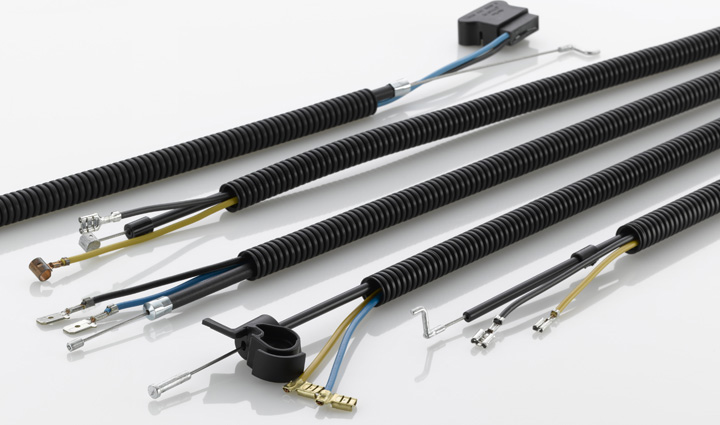
With a fully automatic cable assembly, we are able to process standard crimp contacts.
The assembly of individual conductors creates cable harnesses through which signals and working currents can be transmitted.
In addition to cable assembly, we also offer ready-to-install cable harnesses for the manufacture of ready-to-install electric bowden cables.
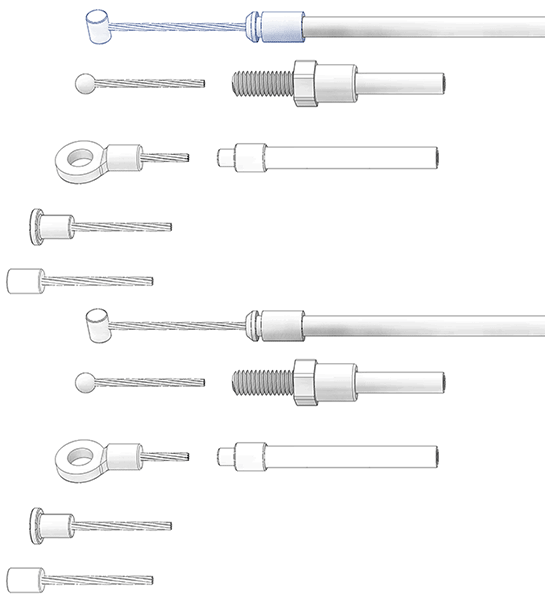
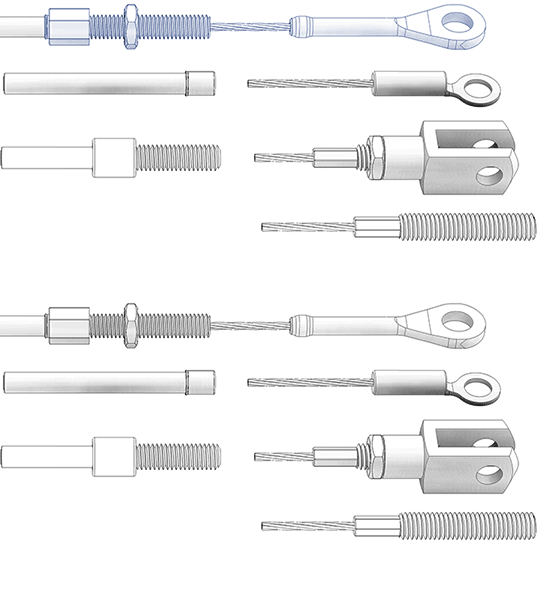
The following examples give you an insight into the extensive variation options. We are able to manufacture customized bowden cable for your application.
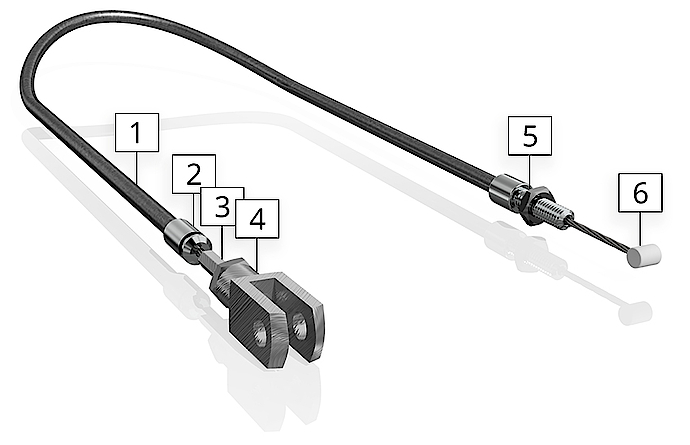
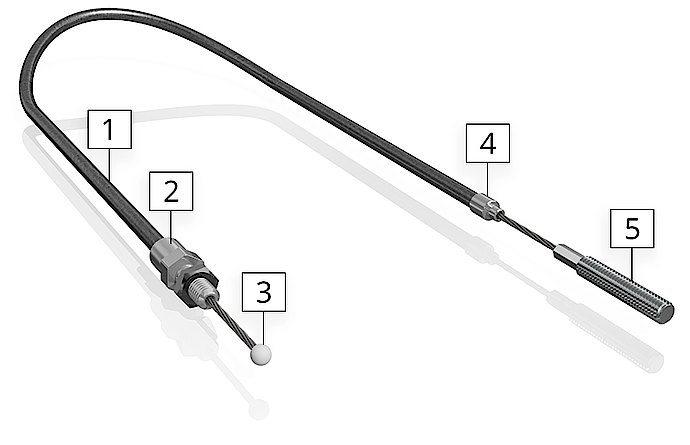
This push-pull spiral (1) consists of a hose socket with groove (2) on the left side and a hose socket with thread (5) on the right side. The prefabricated cable is designed with a swaged thread (3) and a screwed fork head (4). A die-cast crossbar stop sleeve (6) made of fine zinc was sprayed on the right side of the assembled cable.
Flat wire spirals with inner tubes (1) are also used in the automotive industry because of their lower frictional resistance. This flat wire spiral is provided with a threaded hose socket (2) and an end sleeve (4).The assembled cable has a die-cast ball (3) and a die-cast eyelet (5) made of fine zinc.
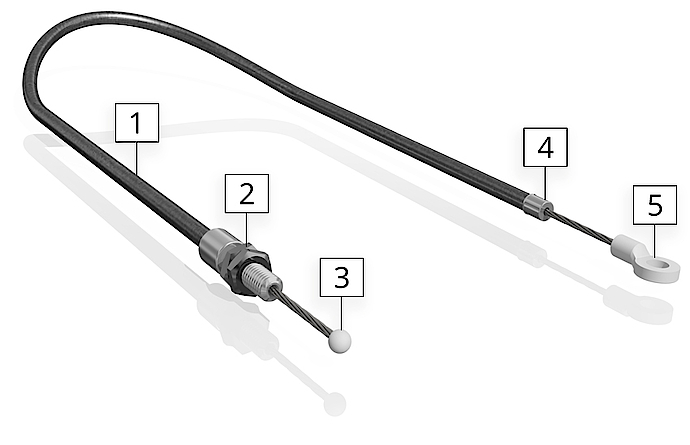
Parts list
| No. | Description | Item No. |
| 1 | Flat wire spiral | SP000010 |
| 2 | End cap | EN000002 |
| 3 | Towing eye | ZU000106 |
| 4 | Hose socket with nut | SA000004 |
| 5 | Die-cast crossbar stop sleeve | WK000036 |
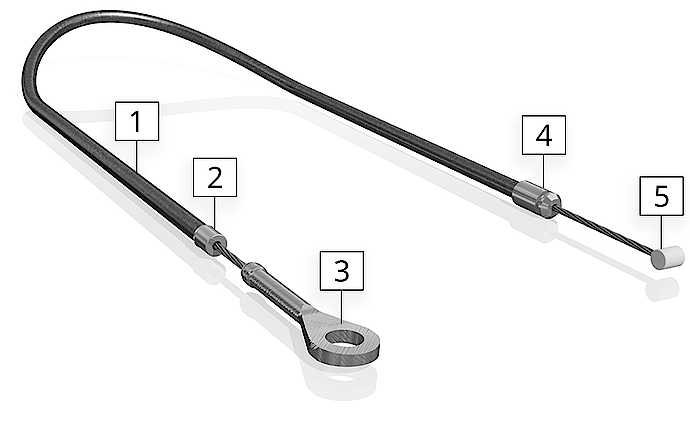
Parts list
| No. | Description | Item No. |
| 1 | Flat wire spiral | SP000352 |
| 2 | End cap | EN000003 |
| 3 | Die-cast stop sleeve | WK000015 |
| 4 | End cap | EN000003 |
| 5 | Die-cast shank end stop | WK000013 |
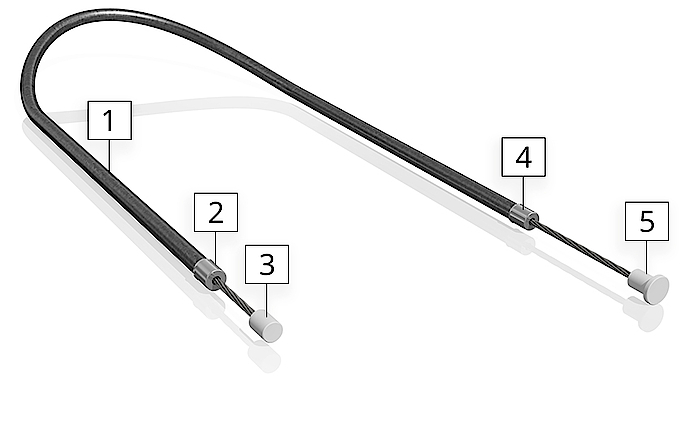
This flat wire spiral with inner tube (1) is manufactured with a threaded hose socket with hexagon (2) and an necked hose socket (4).The versatile cable is equipped with a die-cast ball (3) and a swaged thread (5).
Konkavex sytem bowden cables offer an absolutely pressure resistant casing. This results in a much higher efficiency compared to a conventional bowden cable. The basic elements are threaded together on a fluoropolymer liner. This liner serves as an inner coating for the cable as well as a support for the basic elements. With their unique design the aligned basic elements form a bowden cable which is extremely flexible and highly pressure resistant at the same time. This system is suitable for cable Ø 1,2- 1,5 mm.
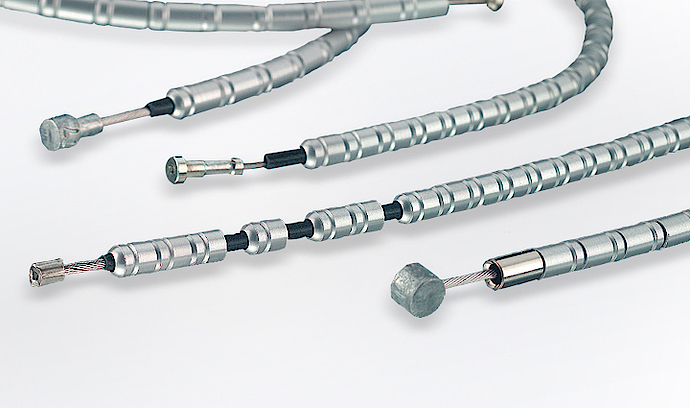
A bowden cable is a mechanical force transmission system consisting of a flexible, pressure-resistant outer sheath and a cable or wire running inside it. When the inner cable is actuated, it transfers a mechanical force or movement from the operating element to the functional component.
The bowden cable operating principle allows forces and movements to be transmitted flexibly, including around bends and between components that are physically separated. Depending on the design, bowden cables can be used for actuation, release, adjustment and unlocking mechanisms.
A push-pull cable, also known as a push-pull bowden cable or push-pull control cable, is designed to transmit both tensile and compressive forces.
Unlike a conventional bowden cable, which is primarily used to transmit pulling forces, a push-pull cable enables movement in both directions. This makes it suitable for mechanical control, adjustment, switching and actuation applications.
The key difference is the type of force that can be transmitted. A conventional bowden cable is primarily designed to transmit tensile forces, whereas a push-pull cable can transmit both tensile and compressive forces.
The appropriate solution depends on the application, required forces, stroke, cable routing and bending radii.
The construction of a bowden cable consists essentially of an inner cable and an outer bowden sheath. Depending on the application, the inner cable can be a wire rope, wire or strand.
Additional components such as an inner liner, guides, end fittings and connection elements can also be incorporated. The individual components are selected and configured according to the requirements of the application.
Bowden cables enable flexible mechanical force transmission in a compact design. Key advantages include:
Through application-specific design, bowden cables can also be adapted to demanding technical applications and restricted installation spaces.
The forces that can be transmitted by a bowden cable depend on its design and operating conditions. Important factors include the inner cable, diameter, material, outer sheath, cable length, bending radius and routing.
A conventional bowden cable is primarily used to transmit tensile forces. A push-pull cable, on the other hand, is designed to transmit both tensile and compressive forces.
The required operating forces, potential peak loads and expected service life should be considered during the design process.
The permissible bending radius of a bowden cable depends on its construction and the components used. Factors include the diameter and construction of the inner cable, the outer sheath and any inner liner.
The bending radius should be considered during the design process. Excessively tight or repeated bends can increase friction and wear and affect the required actuation force.
The correct bowden cable design starts with the requirements of the application. Important factors include:
Based on these requirements, the inner cable, outer sheath, liner, materials and end fittings can be selected and configured for the specific application.
Bowden cables can be configured using different wires, wire ropes, strands, outer sheaths, liners and connection components. The selection depends on factors such as strength, flexibility, friction, temperature resistance, corrosion resistance and service life.
Special inner liners can also be used to optimise the sliding properties. Bowden cables with integrated electrical cables can combine mechanical actuation and electrical transmission within a single solution.
Various end fittings and connection elements can be used depending on the application. These include, for example, balls, nipples, cable terminals, threaded connections and loops.
The appropriate end fitting depends on the connection to the operating and functional components, the forces involved, available installation space and required tolerances.
In addition to standard components, customised end fittings can also be developed and assembled.
Yes. Custom bowden cables and push-pull cables can be developed and manufactured according to the specific requirements of an application.
The inner cable, diameter, material, outer sheath, liner, length and end fittings can all be configured to suit the application. Custom solutions and ready-to-install cable assemblies are also possible.
For standardised configurations, a bowden cable configurator can support the initial selection of components and variants. For complex technical applications, individual engineering and technical consultation are recommended.
Carl Stahl Technocabels develops and manufactures custom bowden cables and push-pull cables at its headquarters in Germany.
By combining development, in-house wire rope manufacturing and cable assembly, we can produce application-specific bowden cable solutions and ready-to-install assemblies.
As custom bowden cable manufacturers, we support customers from the selection and design of the cable through to the finished cable assembly.
For the design of a bowden cable, information on the required force, operating stroke, cable length, bending radius, installation space and service life is particularly useful.
For push-pull applications, both tensile and compressive forces should be specified. Additional information such as temperature, moisture, chemicals, corrosion, actuation speed, required end fittings and existing technical specifications should also be provided.
Drawings, technical data, samples or information about an existing solution can further support the design process.
The more precisely the requirements are defined, the more accurately the bowden cable, components and end fittings can be matched to the application.
Requirements analysis for bowden cables and push-pull cables